

Read The Fabricator’s article featuring PEP’s advanced automation and intelligence!
Read The Fabricator’s article featuring PEP’s advanced automation and intelligence!

Steel and aluminum are among the most expensive materials in any fabrication operation, and poorly arranged nests waste that material. Fabricators face pressure to reduce waste for better profit margins and from customers, supply chain partners and ESG-minded investors. Sustainable waste reduction for sheet metal fabrication requires technology-driven tactics to deliver measurable results on the balance sheet and the sustainability report.
At the cutting stage, suboptimal part layouts, excessive gaps between parts, inconsistent programmer output and unnecessary head raises lead to real material loss during every run. Inefficient arrangements turn unused space into scrap, operator variation creates inconsistent material efficiency, and excess repositioning moves the machine without adding value.
An industry survey shows scrap and rework comprised 1.4% of sales on average across fabrication operations. That percentage represents unrecovered spend that compounds across every shift and every job, and for high-volume steel service centers operating on tight margins, the impact is even more acute.
Every square inch of uncut scrap carries embedded labor, machine time and overhead on top of the raw material cost. A scrapped part represents wasted operational capacity, making this fundamentally a profitability problem before it becomes an environmental one.
Lean practices, operator training and better scheduling help you do more with the waste already created. However, sustainable fabrication waste reduction for sheet metal starts at nesting, where you decide how much waste you create in the first place. The result is eco-friendly fabrication efficiency that reduces both material spend and waste stream volume before a single cut is made.
Fully automatic nesting software arranges parts on steel and aluminum sheets to extract maximum material yield on every job with zero manual programmer involvement.
These two mechanisms deliver measurable green nesting software profitability gains:
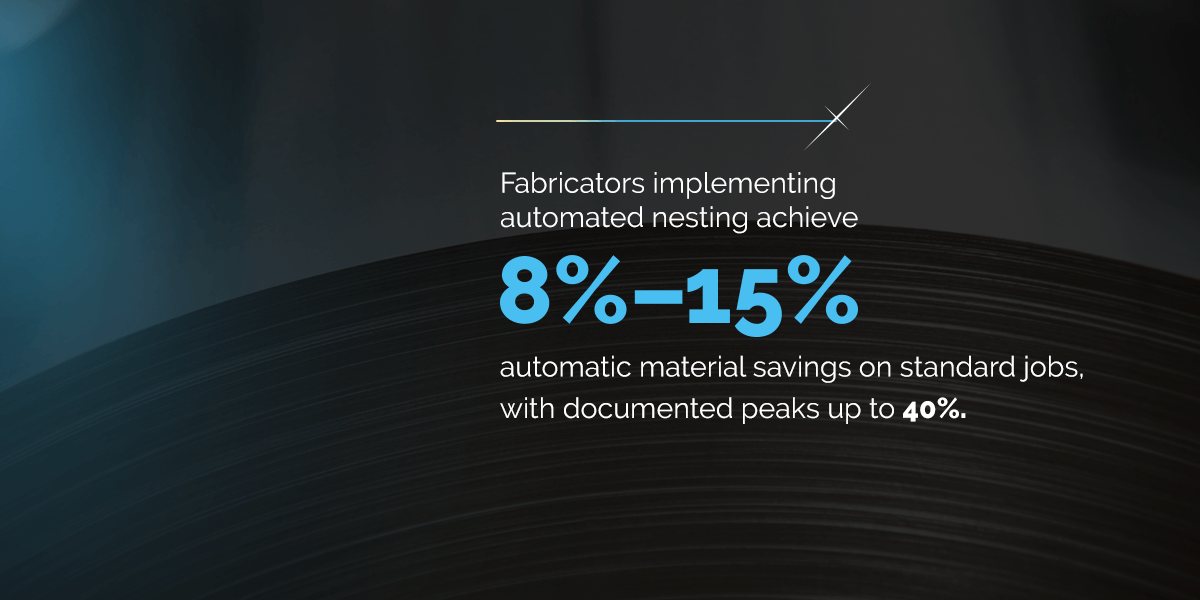
Fabricators achieve 8–15% automatic savings on standard jobs using automatic nesting software, with documented peaks reaching 40% in high-complexity applications and 28% in mixed-part environments.
Common line cutting means adjacent parts share a single path instead of each requiring its own cut. This method reduces total distance traveled, tightens part spacing and generates far less heat in the plate. Standard approaches require individual paths plus wider spacing to prevent warpage, but common line cutting solves both challenges simultaneously.
Advanced nesting systems can handle even parts with rounded corners. These platforms often decrease travel distance by about 30%, with one fabricator eliminating 36% of total inches across mixed jobs and another reducing the figure by 32% on laser CNC operations. Lower heat in the plate reduces warping and improves edge quality. Additionally, the software identifies shared-line candidates and executes the optimization fully automatically.
Automated nesting delivers measurable financial returns through reduced material costs, scrap value recovery and fast implementation payback.
Every percentage point of material utilization gained means less scrap, more parts per sheet and lower material costs that directly improve profitability. Fabricators implementing automated nesting achieve 8%–15% automatic material savings on standard jobs, with documented peaks up to 40%. Software eliminates the inconsistency of manual optimization, and you reduce waste and material spend now while building a quantifiable material efficiency record.
Daimler Freightliner saved $680,000 in material costs during year one and achieved up to 20% in sheet savings. The automated system included critical programming tasks in every nest that programmers couldn’t complete manually due to time constraints, resulting in significantly better material utilization across all jobs.
Optimized nesting generates less scrap, which means less material entering the waste stream with lower disposal cost. The remnants that are produced can be tracked and reused through inventory management, so future jobs nest against leftover stock rather than cutting fresh sheets, turning leftover stock into future revenue.
Automated nesting software has a typical payback timeline of three to 12 weeks — material savings and throughput gains quickly offset the cost of implementation. However, actual ROI timing depends on factors like material spend, job volume and part mix.
Sustainable fabrication is also an externally measured expectation from large customers and OEM supply chains, where procurement requirements increasingly screen for documented ESG performance.
When fabricators consume fewer sheets, they require less raw steel and aluminum and reduce demand for carbon-intensive primary metal production. Steel production accounts for 7%–8% of global greenhouse gas emissions, with an emission intensity of approximately 2.18 tonnes of CO₂e per tonne produced, so every sheet saved carries real carbon value.
Primary aluminum production generates roughly 8,455 kg of CO₂e per tonne. Optimized nesting reduces the need for fresh primary stock and lowers energy consumption per run across the production floor through shortened operation times and reduced machine cycles per completed order.
Precision cutting and remnant management support circular economy principles by keeping steel and aluminum in productive use longer, which reduces demand for virgin material extraction and its associated processing emissions.
Automatic nesting and cutting software bridges the gap between daily shop decisions and sustainability documentation. Every job’s nest, sheet pull, remnant reuse and scrap output is logged automatically, so every saved sheet becomes a verifiable metric. The operational record that accumulates over time can feed customer questionnaires, sustainability reporting or efficiency reviews, turning daily nesting data into documented ESG manufacturing compliance ROI.
Suppliers and customers increasingly screen partners on sustainability performance and supply chain risk. A shop that can prove waste reduction is easier to onboard as a supplier under CSRD, ESRS, CDP or corporate programs. This documentation matters for job shops and contract fabricators competing for work where environmental criteria function as an RFQ filter.
PEP Technology delivers automatic waste reduction backed by 46 years of real-world refinement. Fabricators implementing our fully automatic nesting software achieve measurable savings quickly. Our software works with any laser CNC, plasma or waterjet machine through over 700 post-processors, with SolidWorks and Inventor integration built in — no equipment replacement required.
Nest with the best. Contact us to learn more about how you can minimize waste in your fabrication operations.